Using Impact Funds to Improve Portfolio Resilience and Return
Investment mandates are crucial to proper governance. Properly constructed, they ensure alignment between an institution’s mission, financial needs and investment activities. They often consist of a formal, binding set of rules, goals, and constraints set by a qualified oversight board or autonomous investment committee. They delineate acceptable risk, broad asset allocation, benchmarks and – often but not always – exclusions. They are not subject to frequent revision, nor should they be. They are GPS systems that are supposed to perform across all macroeconomic scenarios.
The role of impact investing in these institutional investment mandates varies. Some institutions follow explicit “impact-first” allocation guidelines, meaning they segment a portion of their assets for some specific impact cause or causes that are not necessarily designed for return optimization. Others do not think of impact as a separate asset class, or even a mandate worth pursuing. As we discuss below, this can lead an investment committee to overlook a growing number of impact investment opportunities that could create more optimal risk-adjusted returns, and more resilient portfolios.
Multiple university endowments have told us that impact investing is precluded by their investment mandate. They regard impact investing to be a form of philanthropy, something their endowment spending is for, not their endowment return. While this viewpoint is understandable for certain types of impact investments, it does not reflect the growing body of investments which successfully pursue a dual mandate of impact + return. As we have often argued and shown, many impact investment strategies aren’t concessionary risk/ reward opportunities. Moreover, a number of impact investment strategies may improve overall portfolio construction by adding uncorrelated sources of attractive, risk-adjusted return. At IEL, we call increasing portfolio efficiency and resilience through the integration of impact investment strategies “Ultra-Modern Portfolio Theory.”
Most endowments and foundations spend their investment proceeds on mission-aligned causes – things like student scholarships and stronger academic programs, or health, environmental and educational programs. To fund these activities, the vast majority of their investment mandates are optimized for return versus a risk limit. In essence, they construct risk-aware investment portfolios that are intended to fund their operations in perpetuity. This approach to portfolio construction - first popularized by Nobel-Prize winning economist Harry Markowitz - is known as Modern Portfolio Theory (MPT).
MPT encompasses two concepts: risk and return. The end result is a portfolio optimization technique which attempts to either maximize returns for a given amount of risk or minimize risk relative to a target return. In the first case, minimizing the probability of an unacceptable loss is the core concern; in the latter, heightening the probability of achieving a target return is prioritized.
Investment diversification comprises the heart of this optimization exercise. Markowitz’s fundamental, indeed Nobel-prize winning insight was that constructing portfolios of assets that perform in directionally different manners under varying macroeconomic circumstances will reduce the volatility of a portfolio overall without proportionately altering its total return characteristics. For example, bond and stock prices often (though not always!) move in different directions over an economic cycle: the latter are broadly benefited by improving economic growth, while the former are broadly benefited by slowing economic growth. If one constructs portfolios comprised of assets with low-to-inverse correlations like stocks and bonds, the overall portfolio can become less volatile without penalizing total return axiomatically. When MPT is properly deployed, investors will get the same return for less risk, or more return for the same amount of risk.
Figure 1 provides a visual depiction of Modern Portfolio Theory. The x-axis represents expected returns, while the y-axis represents risk in terms of standard deviation. Each dot represents a different, prospective portfolio comprised of multiple assets. The thick blue line is known as the “Efficient Frontier.” It is so-designated because it delineates the risk/ return tradeoff for all possible portfolios. The goal of portfolio optimization is to move the projected risk/ return of a given portfolio that lies below the thick blue line as close to the Efficient Frontier as possible. Risk/return optimized investment mandates effectively increase one’s prospective return without adding risk, or they lower one’s risk for a given return target.
Figure 1: Portfolio Risk-Return Optimization
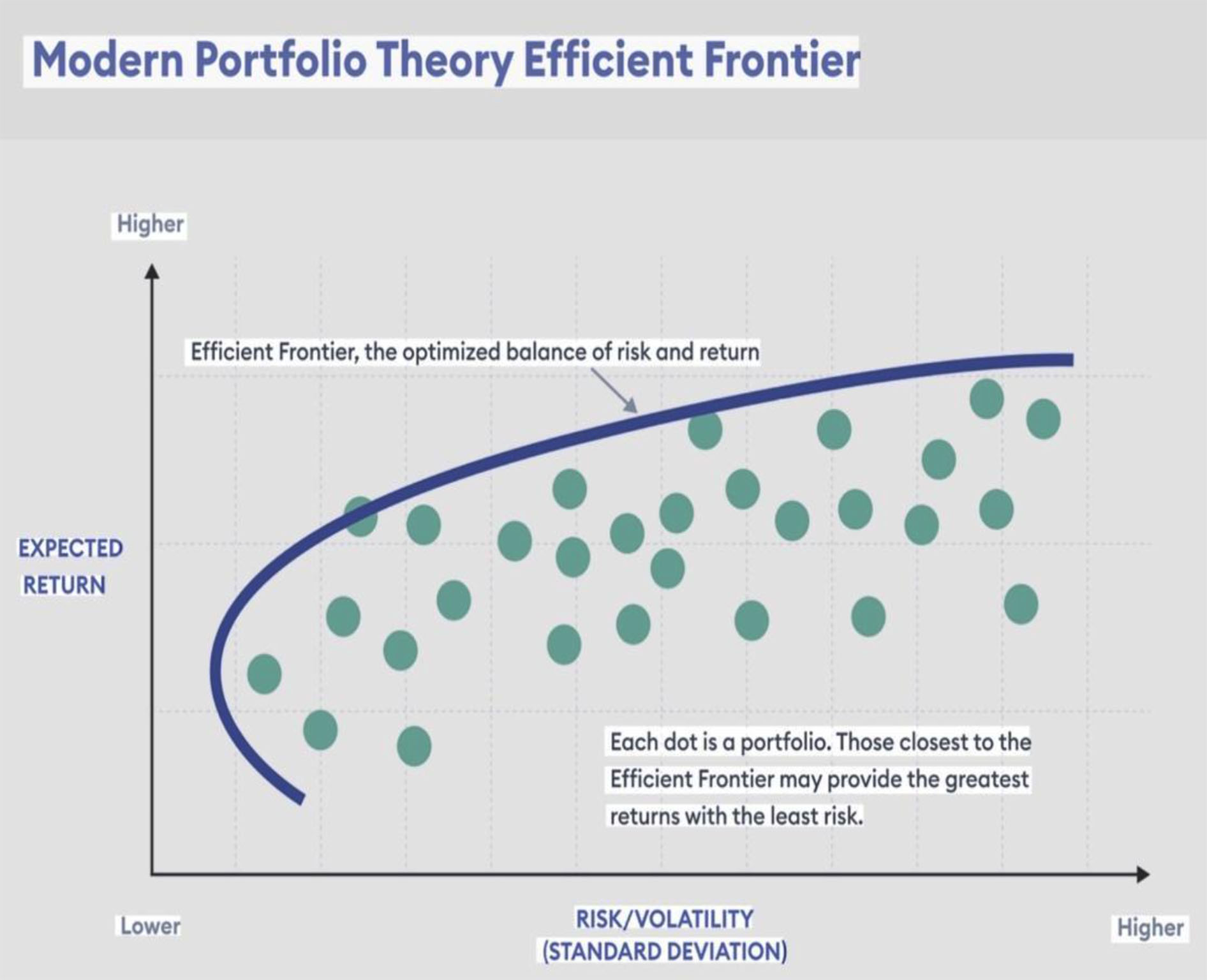
So how might Ultra-Modern Portfolio Theory (UMPT) work in practice? In essence, UMPT would seek to identify specific impact investment strategies which have the capacity to lower portfolio risk, increase portfolio returns, or both – effectively moving the green dots closer to the Efficiency Frontier. It does not involve – as some others have suggested – a three-dimensional Efficiency Frontier, based upon risk, return and impact. Rather, for an institutional investor allocating capital, impact funds that are relatively uncorrelated to the existing portfolio of funds are sought. And such impact funds do exist. Two of the most promising types are affordable housing funds, and microfinance funds.
Similar to Figure 1 above, Figure 2 below depicts the risk/ return characteristics of nine asset classes calculated by the National Council of Real Estate Investment and the Federal Reserve, as of June 2024. In both figures, the x-axis represents expected returns, while the y-axis represents risk in terms of standard deviation. Figure 2 illustrates what IEL has noted in our review of individual affordable housing funds: namely, that many such funds generate reliable, double digit returns while exhibiting considerably lower volatility than other asset classes, including US equities, REITs and other forms of real estate investing, including retail and non-affordable housing. Moreover, affordable housing funds have a potentially low-to-inverse correlation with economic growth: demand for low-income housing rises during economic downturns, keeping occupancy rates at an historic average of 97%. This is well above other real estate segments. High, real returns that become more stable during periods of economic weakness can potentially improve portfolio resilience and promote more optimal risk-reward outcomes across multiple macro scenarios.
Figure 2: Total return vs. risk, 2011-2023
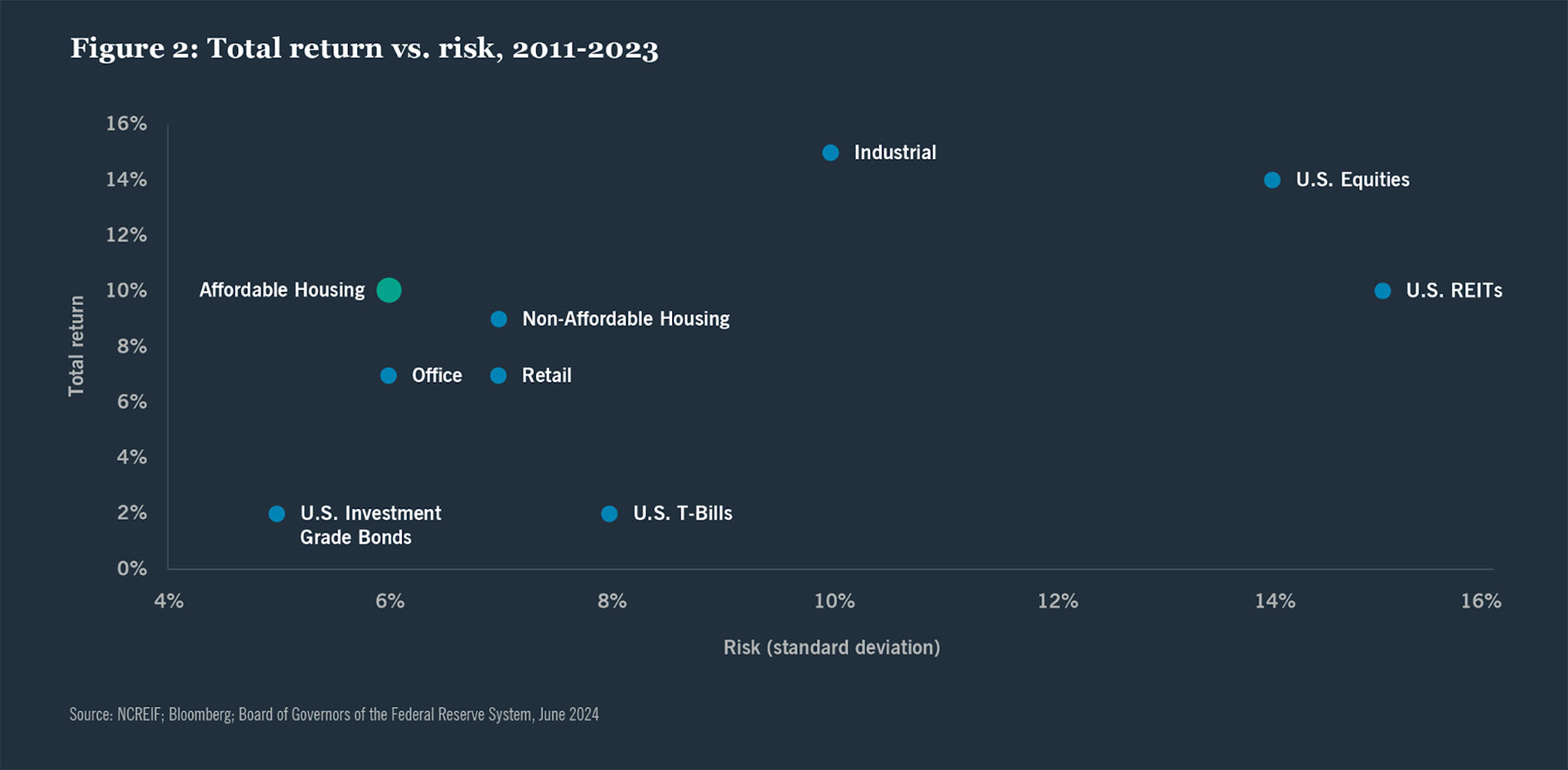
We understand these concepts may be surprising to many, so let us delve a bit deeper. To begin with, one will be hard pressed to find many asset classes that generate 10%+ returns with historic volatility of around 6% that are inversely correlated to most other risk assets. The fact that affordable housing funds can do so while helping to resolve one of the greatest social challenges facing America today is a double reason to consider them. In strictly financial terms, affordable housing funds can play potentially valuable roles in improving risk-adjusted returns, moving the portfolios of many endowments, foundations and family offices closer to their (now, ultra-modern!) Efficiency Frontier.
A second category of impact funds which may be able to add broadly stable, low-volatility returns with low correlation to broader public markets are microfinance investment vehicles (MIVs). According to the Journal of Quantitative Economics, through 2025, MIVs as an asset class exhibited average annual returns of 3-6% against a volatility of 1-3%, positioning them quite favorably versus US Investment Grade Bonds and US T-bills (as represented in Figure 2). Their liquidity is considerably lower than T-bills and most corporate bonds, of course, but their risk/ return profiles are comparably attractive.
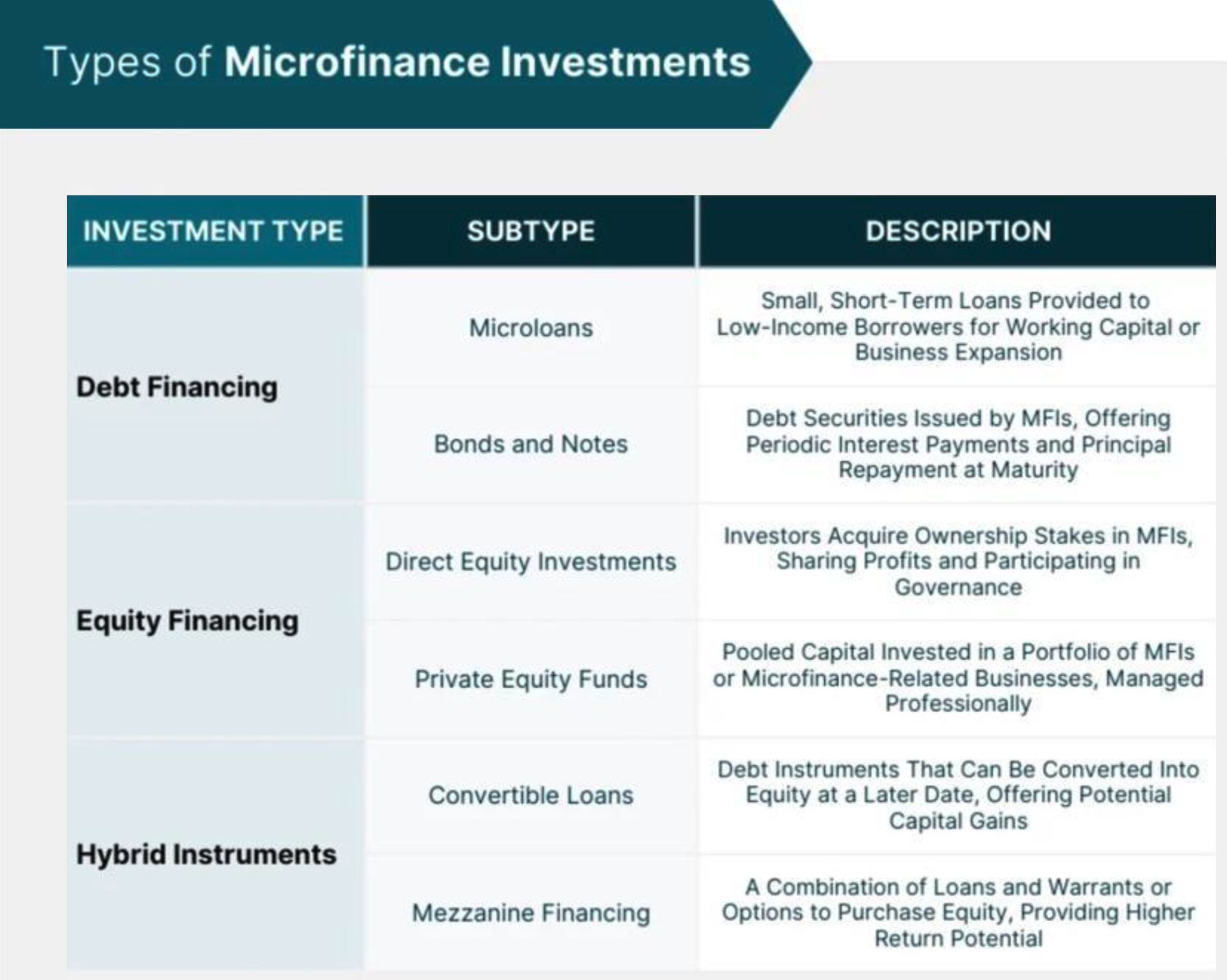
MIVs can be comprised of debt, equity and/or hybrid instruments (see Figure 3). Since being introduced by Nobel Peace Prize winning economist Muhammed Yunus and the Grameen Bank beginning in 1983. Microfinance lending has since become a large, globally diverse and expanding market. It is now projected to grow from more than $300 billion in 2025 to $876 billion by 2035. All MIVs involve the extension of debt or equity capital to small, often under-banked or non-banked institutions or individuals.
Figure 3: Types of Microfinance Investments
While low-volatility, high return MIVs can improve total portfolio resilience and return, just like affordable housing funds, MIVs are not all created equal. Investors must due diligence the asset originator and managers of all MIVs very carefully. While some have enviable net-charge-off (NCO) rates that rival or even exceed those of experienced lenders, others have experienced NCOs as high as 30%. One way to assess whether an affordable housing fund or MIV is appropriate for you is to first consider all those who have completed our Impact Authenticity Score process. If our initial due diligence suggests a deeper look is warranted, you should then meet with the manager or managers that seem most likely to add resilience and improve your overall risk/ return profile.
Conclusion
Endowments and foundations dedicated to promoting beneficial social, educational, environmental, economic and health outcomes often think of their investment mandates as a risk/ reward optimization challenge subject to chosen constraints. In practice, this has led many to rely on incomplete assumptions about impact investment returns, and the preclusion of all impact investment strategies. As we have shown above, this investment bias – excluding all impact investment strategies – may well result in sub-optimality. If one regards risk/ reward optimization in strict Markowitzian/ MPT terms, formal consideration of some impact investment strategies should come into play. MPT requires the consideration of any and all established asset classes and investment strategies that can improve overall portfolio resilience and risk-adjusted return. In the case of established impact investment strategies, our analysis suggests some affordable housing funds and certain microfinance investment vehicles may well be suited to promote optimization, moving overall portfolios closer to their Efficiency Frontier. In these cases, endowments and foundations need not face a tradeoff between doing well and doing good: they can do both.
In this modern era characterized by financial abundance – when total investable assets for the first time in human history across all debt, equity, infrastructure, commodity, money-market and bank lending are now nearing $1 quadrillion – it is incumbent upon all asset owners to ask themselves if and how their investment capital can verifiably contribute to human flourishing while simultaneously achieving their specific financial goals. Endowments and foundations which are publicly dedicated to noble causes can lead by example - not by abandoning their historic commitments to Modern Portfolio Theory, but by enhancing it with impact funds and embracing the framework of Ultra-Modern Portfolio Theory. IEL stands ready to help any and all that do.